[from Buenos Aires Perception, 26 October 2009]
A cartonero (cardboard picker) is someone who digs through the trash to collect anything that may be of value. Basically, they are sorting through the garbage set out at the curb, mostly in search for cardboard and other useful remains. The cartoneros work within certain territories in the various neighborhoods of Buenos Aires. Sadly, there are thousands of them out on the streets, many are children. The number of cartoneros has rapidly increased during the last economic crash in 2001. For many people in Argentina, that is the only way to make a living.
Showing posts with label quality of life. Show all posts
Monday, April 18, 2011
Thursday, March 3, 2011
Saturday, February 26, 2011
onsite
We rented a car this morning & drove from Salta to Cafayate. Yes, it's true: water is flowing over Route 40, & the road has washed away in 2 places.
Crews have cut new road out of the hillsides, farther from the water.
The washouts will take time to rebuild. Because the traffic was very light, & in spite of a 50- to 100-rider bicycle pod that slowed our speed to 20 mph, we managed the trip in 3 1/2 hours.
La Estancia is quiet & wonderful. Fabiola was here to let us into Ginny Biddle's house, which we are renting. We ate llama sausage & goat cheese for lunch. Now Mike is napping while I sit outside the sales office in order to blog. Except for the lack of an extension cord, we are told that Internet would be working in the house.
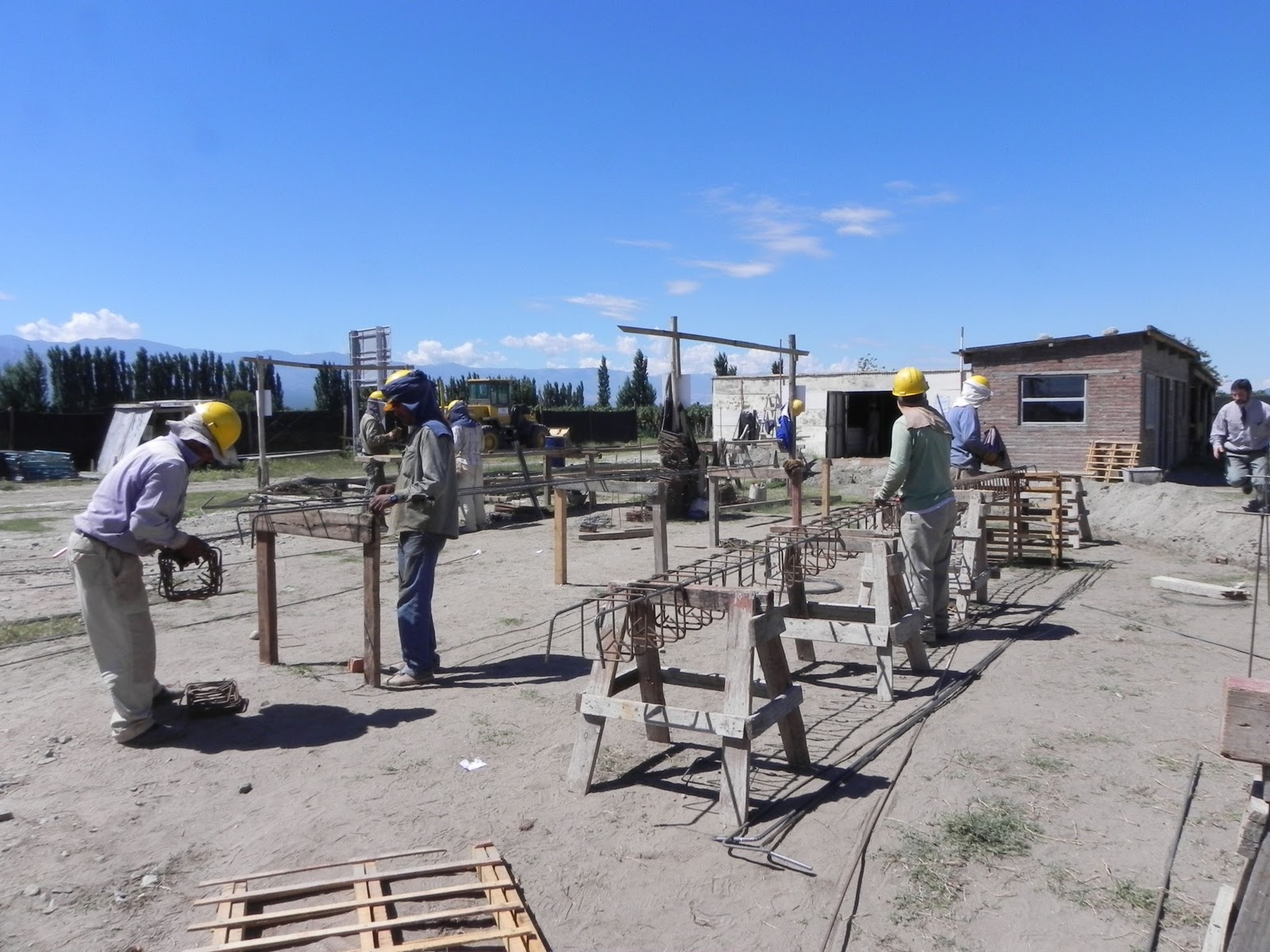
We briefly toured our house after lunch, took many photos that are right now uploading to the Cala House blog. I've been bird & butterfly watching. Sulfurs everywhere. Hummingbirds & giant golden hornets at the sales office. Stilts in the weeds. I can hardly wait to walk around the ponds. I stopped to photograph this bird working at the big construction shed.
Crews have cut new road out of the hillsides, farther from the water.
The washouts will take time to rebuild. Because the traffic was very light, & in spite of a 50- to 100-rider bicycle pod that slowed our speed to 20 mph, we managed the trip in 3 1/2 hours.
La Estancia is quiet & wonderful. Fabiola was here to let us into Ginny Biddle's house, which we are renting. We ate llama sausage & goat cheese for lunch. Now Mike is napping while I sit outside the sales office in order to blog. Except for the lack of an extension cord, we are told that Internet would be working in the house.
We briefly toured our house after lunch, took many photos that are right now uploading to the Cala House blog. I've been bird & butterfly watching. Sulfurs everywhere. Hummingbirds & giant golden hornets at the sales office. Stilts in the weeds. I can hardly wait to walk around the ponds. I stopped to photograph this bird working at the big construction shed.
Saturday, February 5, 2011
One Side of the Story
When you read Joel Bowman's article (posted below), which admiringly remarks that
"At the turn of the 20th century, Argentina was ranked as the 8th most prosperous nation on earth. . . . In 1913, Argentina’s bustling, cosmopolitan capital, Buenos Aires, had the thirteenth highest per capita telephone penetration rate in the world. Her per capita income was, around this time, 50% higher than in Italy, almost twice that of Japan and five times greater than its northern neighbor, Brazil."
remember that this ranking & quality of life were enjoyed by Argentina's ruling class, a small percentage of the population made up of landowners & aristocrats, mostly descendants of the Spanish colonizers, locally called criollos, while the unremarked commoners in the provinces lived like 16th century serfs.
[from Joel Bownam @ The Daily Reckoning, 5 February 2011]
Don’t Cry for Argentina
Buenos Aires, Argentina –
To be immortal is commonplace; except for man, all creatures are immortal, for they are ignorant of death; what is divine, terrible, incomprehensible, is to know that one is immortal.
~ Jorge Luis Borges
Everything is illuminated against its opposite; truth against fallacy; light against darkness; life against death. And who would have it any other way, even if they could? What would life, for instance, be without the eternity of its terminally mysterious counterpoint?
If there exists a perfect setting for these and associated meditations, it must surely be the magnificent Recoleta Cemetery, located right here in Buenos Aires. On any given weekend, this sacred resting place for thousands of the city’s most famous – and infamous – people is found to be one of the liveliest places in town. Notable internments include a who’s who list of Argentine writers, painters, poets, musicians, scientists and luminaries from other noble fields of interest. And, because nothing, including death, is beyond the law of equilibrium, a handful of politicians also rot underfoot.
Tourists pour in to adorn Maria Eva Duarte de PerĂ³n’s grave with flowers, bypassing the resting place of a Nobel Prize-winning chemist and a dozen honest writers to do so. Other, temporary attendees pose with bright smiles to have their picture taken beside the weeping cement angels, frozen, as they are, in a state of perpetual sorrow. Young boys give the “peace” symbol next to the resting places of generals whose armies laid waste to tens of thousands of men, the bodies of whom are long forgotten, their own graves unmarked.
Nowhere does irony live a fuller life than in a cemetery.
Walking around the grounds, reading the dates on the tombs, one is reminded of the finite nature of all things; organisms, currencies, political regimes, class structures. When the cemetery was constructed, in 1822, it must have been a good ride from the exclusive barrios of San Telmo and Montserrat. The rich probably wouldn’t have been caught dead around the grounds of the Monks of the Order of the Recoletos, nor near the shabby, patchwork graveyard that was built there the same year the group disbanded.
Half a century later – and with Argentina still reeling from the War of the Triple Alliance and it’s own, subsequent civil war – a yellow fever epidemic tore through the capital city. Its wealthier, southern quarters were among the worst hit areas. Death toll estimates range from thirteen to twenty-five thousand. The clase alta packed up and moved north, largely into and around the Recoleta barrio. As such, the marbled vaults came to be populated with members of this same aristocracia, who, though they escaped the fever, came to rest here eventually just the same.
Today, you could buy an entire building in San Telmo for the same price as some of the finely appointed homes in Recoleta. An entire block in Montserrat might go for half that much.
And so it goes. People die…cities and empires crumble to the ground…and time, indifferent to the fleeting anguishes and triumphs of men, presses on.
***
At the turn of the 20th century, Argentina was ranked as the 8th most prosperous nation on earth. Only Belgium, Switzerland, Britain and a handful of former English colonies – including the United States – were more favorably positioned, economically. In 1913, Argentina’s bustling, cosmopolitan capital, Buenos Aires, had the thirteenth highest per capita telephone penetration rate in the world. Her per capita income was, around this time, 50% higher than in Italy, almost twice that of Japan and five times greater than its northern neighbor, Brazil. Argentina’s industry churned out quality textiles and frigorificos (refrigerated ships) carried her prized beef, first introduced in 1536 by the Spanish Conquistadors, from the fertile plains of the pampas to the farthest reaches of the known world.
As the century wore on, protectionist policies at home and increased competition from the post-WWII, export-led economies abroad colluded to undermine Argentina’s international edge. From 1900 through to the beginning of the new millennium, Argentina’s real GDP per person grew at a rate of 1.88% per year. Brazil outpaced her handily, clocking a 2.39% annualized growth rate. Japan, starting with a real GDP per person of just over $1,500 (2006 dollars) at the turn of the twentieth century, grew an average of 2.76% per year. By the middle of this decade, Japan’s real GDP per person was double that of Argentina.
War, currency debasement, civil unrest, military rule and the usual catalyst of politicians, equally corrupt and inept, all conspired to stultify Argentina’s vast potential. The great Argentine poet and essayist, Jorge Luis Borges, described one such retarding factor with characteristic flare and wit: “The Falklands thing was a fight between two bald men over a comb.”
***
On a comfortable Sunday afternoon, late in the spring of 2010, an elderly group of men met at their favorite restaurant, right by the gate to La Recoleta Cemetery, for lunch. They took a table outside, one in the shade and with a view of the passing foot traffic. The waiters, having brought the men the same thing, more or less, every Sunday for as long as they could remember, immediately set about filling their table. There was bife de lomo with achuras and chorizo sausages, mozzarella and buffalo tomatoes and papas fritas by the pile. Rich, Argentine Malbecs and Carbenets flowed freely and the merriment of the group soon became infectious. They flirted with the pretty waitresses and joked with patrons at the nearby tables.
After more than a few bottles, one of the gentlemen got chatting with an Australian editor of no particular importance.
“I am a judge here,” he eventually told the younger man. “My friends and I have seen it all in this city…riots, economic crises, war, people’s entire life savings wiped out overnight.”
One of his friends lent over and placed a knowing hand on the judge’s shoulder. “Today, we enjoy the moment,” he said to his lifelong friend, before adding, with a hearty laugh, “because tomorrow…ha ha…well, you know our next stop old man.”
In the background, the sun had already begun to fade from the domes atop La Recoleta Cemetery.
"At the turn of the 20th century, Argentina was ranked as the 8th most prosperous nation on earth. . . . In 1913, Argentina’s bustling, cosmopolitan capital, Buenos Aires, had the thirteenth highest per capita telephone penetration rate in the world. Her per capita income was, around this time, 50% higher than in Italy, almost twice that of Japan and five times greater than its northern neighbor, Brazil."
remember that this ranking & quality of life were enjoyed by Argentina's ruling class, a small percentage of the population made up of landowners & aristocrats, mostly descendants of the Spanish colonizers, locally called criollos, while the unremarked commoners in the provinces lived like 16th century serfs.
[from Joel Bownam @ The Daily Reckoning, 5 February 2011]
Don’t Cry for Argentina
Buenos Aires, Argentina –
To be immortal is commonplace; except for man, all creatures are immortal, for they are ignorant of death; what is divine, terrible, incomprehensible, is to know that one is immortal.
~ Jorge Luis Borges
Everything is illuminated against its opposite; truth against fallacy; light against darkness; life against death. And who would have it any other way, even if they could? What would life, for instance, be without the eternity of its terminally mysterious counterpoint?
If there exists a perfect setting for these and associated meditations, it must surely be the magnificent Recoleta Cemetery, located right here in Buenos Aires. On any given weekend, this sacred resting place for thousands of the city’s most famous – and infamous – people is found to be one of the liveliest places in town. Notable internments include a who’s who list of Argentine writers, painters, poets, musicians, scientists and luminaries from other noble fields of interest. And, because nothing, including death, is beyond the law of equilibrium, a handful of politicians also rot underfoot.
Tourists pour in to adorn Maria Eva Duarte de PerĂ³n’s grave with flowers, bypassing the resting place of a Nobel Prize-winning chemist and a dozen honest writers to do so. Other, temporary attendees pose with bright smiles to have their picture taken beside the weeping cement angels, frozen, as they are, in a state of perpetual sorrow. Young boys give the “peace” symbol next to the resting places of generals whose armies laid waste to tens of thousands of men, the bodies of whom are long forgotten, their own graves unmarked.
Nowhere does irony live a fuller life than in a cemetery.
Walking around the grounds, reading the dates on the tombs, one is reminded of the finite nature of all things; organisms, currencies, political regimes, class structures. When the cemetery was constructed, in 1822, it must have been a good ride from the exclusive barrios of San Telmo and Montserrat. The rich probably wouldn’t have been caught dead around the grounds of the Monks of the Order of the Recoletos, nor near the shabby, patchwork graveyard that was built there the same year the group disbanded.
Half a century later – and with Argentina still reeling from the War of the Triple Alliance and it’s own, subsequent civil war – a yellow fever epidemic tore through the capital city. Its wealthier, southern quarters were among the worst hit areas. Death toll estimates range from thirteen to twenty-five thousand. The clase alta packed up and moved north, largely into and around the Recoleta barrio. As such, the marbled vaults came to be populated with members of this same aristocracia, who, though they escaped the fever, came to rest here eventually just the same.
Today, you could buy an entire building in San Telmo for the same price as some of the finely appointed homes in Recoleta. An entire block in Montserrat might go for half that much.
And so it goes. People die…cities and empires crumble to the ground…and time, indifferent to the fleeting anguishes and triumphs of men, presses on.
***
At the turn of the 20th century, Argentina was ranked as the 8th most prosperous nation on earth. Only Belgium, Switzerland, Britain and a handful of former English colonies – including the United States – were more favorably positioned, economically. In 1913, Argentina’s bustling, cosmopolitan capital, Buenos Aires, had the thirteenth highest per capita telephone penetration rate in the world. Her per capita income was, around this time, 50% higher than in Italy, almost twice that of Japan and five times greater than its northern neighbor, Brazil. Argentina’s industry churned out quality textiles and frigorificos (refrigerated ships) carried her prized beef, first introduced in 1536 by the Spanish Conquistadors, from the fertile plains of the pampas to the farthest reaches of the known world.
As the century wore on, protectionist policies at home and increased competition from the post-WWII, export-led economies abroad colluded to undermine Argentina’s international edge. From 1900 through to the beginning of the new millennium, Argentina’s real GDP per person grew at a rate of 1.88% per year. Brazil outpaced her handily, clocking a 2.39% annualized growth rate. Japan, starting with a real GDP per person of just over $1,500 (2006 dollars) at the turn of the twentieth century, grew an average of 2.76% per year. By the middle of this decade, Japan’s real GDP per person was double that of Argentina.
War, currency debasement, civil unrest, military rule and the usual catalyst of politicians, equally corrupt and inept, all conspired to stultify Argentina’s vast potential. The great Argentine poet and essayist, Jorge Luis Borges, described one such retarding factor with characteristic flare and wit: “The Falklands thing was a fight between two bald men over a comb.”
***
On a comfortable Sunday afternoon, late in the spring of 2010, an elderly group of men met at their favorite restaurant, right by the gate to La Recoleta Cemetery, for lunch. They took a table outside, one in the shade and with a view of the passing foot traffic. The waiters, having brought the men the same thing, more or less, every Sunday for as long as they could remember, immediately set about filling their table. There was bife de lomo with achuras and chorizo sausages, mozzarella and buffalo tomatoes and papas fritas by the pile. Rich, Argentine Malbecs and Carbenets flowed freely and the merriment of the group soon became infectious. They flirted with the pretty waitresses and joked with patrons at the nearby tables.
After more than a few bottles, one of the gentlemen got chatting with an Australian editor of no particular importance.
“I am a judge here,” he eventually told the younger man. “My friends and I have seen it all in this city…riots, economic crises, war, people’s entire life savings wiped out overnight.”
One of his friends lent over and placed a knowing hand on the judge’s shoulder. “Today, we enjoy the moment,” he said to his lifelong friend, before adding, with a hearty laugh, “because tomorrow…ha ha…well, you know our next stop old man.”
In the background, the sun had already begun to fade from the domes atop La Recoleta Cemetery.
Friday, February 4, 2011
EFAM
Susan Ruch brings EFAM, escapefromamericamagazine, to our attention, particularly so that we will read this article:
A Global Positioning System, The Provincial Whore, & The Dead Woman
A Tale Of The Argentine Department Of Highways by Roger Gallo
The Argentine, while predictable; surprises. The dead woman has shrines on every motorway, littered with hundreds of water bottles. Sometimes the shrine is replete with the sculpture of a woman, child at breast, sometimes not. What I at first glance perceived as mounds of debris in front of a Goodwill Box, was a Eucharist-like offering of hundreds of multicolored plastic bottles; belated offerings of water for a woman who died of thirst in the desert. The dead woman, Deolinda Correa, worshipped by the truck drivers of Argentina, was a woman whose husband was forcibly recruited during one of the Argentine civil wars that occurred around 1840. She is now a popular saint through no fault of her own, unofficially, and unrecognized by the Catholic Church. She performs miracles.
The road to my vineyard passed two such shrines. . . . read the rest of the article here.
You might also enjoy Lucy & Matt's Fertility Treatment – Our Experience with IVF in Argentina.
EFAM offers many more articles about Argentina.
A Global Positioning System, The Provincial Whore, & The Dead Woman
A Tale Of The Argentine Department Of Highways by Roger Gallo
The Argentine, while predictable; surprises. The dead woman has shrines on every motorway, littered with hundreds of water bottles. Sometimes the shrine is replete with the sculpture of a woman, child at breast, sometimes not. What I at first glance perceived as mounds of debris in front of a Goodwill Box, was a Eucharist-like offering of hundreds of multicolored plastic bottles; belated offerings of water for a woman who died of thirst in the desert. The dead woman, Deolinda Correa, worshipped by the truck drivers of Argentina, was a woman whose husband was forcibly recruited during one of the Argentine civil wars that occurred around 1840. She is now a popular saint through no fault of her own, unofficially, and unrecognized by the Catholic Church. She performs miracles.
The road to my vineyard passed two such shrines. . . . read the rest of the article here.
You might also enjoy Lucy & Matt's Fertility Treatment – Our Experience with IVF in Argentina.
EFAM offers many more articles about Argentina.
Monday, January 3, 2011
Argentina makes the top 20
David Galland reports today that Argentina made it to the top 20 in International Living's Quality of Life Index.
Read all about it here.
Friday, November 5, 2010
prosperity rankings of Latin American countries
[from MercoPress, Friday, November 5th 2010]
Uruguay the most prosperous country in Latinamerica
says Legatum Institute
Uruguay is the highest positioned Latinamerican country in the 2010 list ranking the prosperity of 110 of the world’s nations by the London analytical centre Legatum Institute and its Legatum Prosperity Index.
“The Prosperity Index seeks to understand how economic fundamentals, health, freedom, governance, safety, education, entrepreneurial opportunity, and social capital influence a country's economic growth and the happiness of its citizens,” the group says.
Europe dominates the Top 10, taking six of the spots: Norway, Denmark, Finland, Sweden, Switzerland and Netherlands. The United States and Canada represent North America, while Australia and New Zealand check in from the Pacific-Asia nations.
In Latinamerica the most prosperous is Uruguay, positioned 28, followed by Chile, 32 and Costa Rica, 33. Argentina ranks 41 and Brazil stands at position 45.
Other Latinamerican countries positions include: Panama, 40; Mexico, 53; Colombia, 65; Paraguay, 67; Peru, 73; Venezuela, 75; Ecuador, 77 and Bolivia 82.
In Europe, UK is ranked 13; Germany, 15; France, 19 and Spain, 23.
Now in its fourth year, the Index analyses 110 nations covering more than 90% of the world’s population and includes both material wealth and quality of life, and then employs a rigorous set of estimation methods to determine which factors matter most to nations’ overall prosperity.
“Most people would intuitively agree that “prosperity” is not just money but also quality of life. The Prosperity Index is the first global index that provides an empirical basis for this belief: it finds that successful countries enjoy a “virtuous cycle” of economic liberty and growth, political freedom and good governance, and enterprising and happy citizens, which mutually reinforce each other on the path to prosperity” points out Legatum Institute.
The most prosperous states are not so much the fastest-growing economies but those democracies that have been able adjust successfully to the emerging reality. At the top of the list are the northern democracies, led by Scandinavian countries Norway, Denmark, Finland and Sweden. These are joined by other small, compact cold-weather states such as the Netherlands and Switzerland. Rounding out the top 9 on the list are three resource-rich Anglo-American states, Australia, New Zealand and Canada.
All these countries sell either resources – Norway, Australia and Canada – to emerging Asian super-powers or expertise and services. Most countries possess powerful niches that drive their economies and promote exports to developing countries. These include green technology (Denmark), motor vehicles, telecommunications, pharmaceuticals and forestry (Sweden), information technology (Finland), engineering and finance (Switzerland), business services, chemicals and plant science (Netherlands). The tiny Netherlands, for example, is China’s second largest European trading partner.
The ability to shift gears also can be seen in Germany which improved its ranking to 15 due in part to rising industrial exports to emerging economies. Like the Scandinavian countries, Germany economy has also become significantly less regulated in the past decade. They are no longer the ultra-generous social welfare states imagined by some liberals , but increasingly adapted to a tougher global marketplace.
This strong performance contrasts dramatically with the emergence of what might called ”a second Europe”, Spain, Portugal, Italy, and Greece which remain functioning democracies but without the kind of effective governance found in their better managed, more fiscally responsible northern neighbours. These states have all fallen in over the past year in the Legatum rankings, falling into the 20s and even 30s, something very rare for long established European economies.
In Latin America, liberal democracies such as Uruguay, Chile and Costa Rica sit on top while minerals rich but autocratic Venezuela and Bolivia sink closer to the bottom.
Uruguay the most prosperous country in Latinamerica
says Legatum Institute
Uruguay is the highest positioned Latinamerican country in the 2010 list ranking the prosperity of 110 of the world’s nations by the London analytical centre Legatum Institute and its Legatum Prosperity Index.
“The Prosperity Index seeks to understand how economic fundamentals, health, freedom, governance, safety, education, entrepreneurial opportunity, and social capital influence a country's economic growth and the happiness of its citizens,” the group says.
Europe dominates the Top 10, taking six of the spots: Norway, Denmark, Finland, Sweden, Switzerland and Netherlands. The United States and Canada represent North America, while Australia and New Zealand check in from the Pacific-Asia nations.
In Latinamerica the most prosperous is Uruguay, positioned 28, followed by Chile, 32 and Costa Rica, 33. Argentina ranks 41 and Brazil stands at position 45.
Other Latinamerican countries positions include: Panama, 40; Mexico, 53; Colombia, 65; Paraguay, 67; Peru, 73; Venezuela, 75; Ecuador, 77 and Bolivia 82.
In Europe, UK is ranked 13; Germany, 15; France, 19 and Spain, 23.
Now in its fourth year, the Index analyses 110 nations covering more than 90% of the world’s population and includes both material wealth and quality of life, and then employs a rigorous set of estimation methods to determine which factors matter most to nations’ overall prosperity.
“Most people would intuitively agree that “prosperity” is not just money but also quality of life. The Prosperity Index is the first global index that provides an empirical basis for this belief: it finds that successful countries enjoy a “virtuous cycle” of economic liberty and growth, political freedom and good governance, and enterprising and happy citizens, which mutually reinforce each other on the path to prosperity” points out Legatum Institute.
The most prosperous states are not so much the fastest-growing economies but those democracies that have been able adjust successfully to the emerging reality. At the top of the list are the northern democracies, led by Scandinavian countries Norway, Denmark, Finland and Sweden. These are joined by other small, compact cold-weather states such as the Netherlands and Switzerland. Rounding out the top 9 on the list are three resource-rich Anglo-American states, Australia, New Zealand and Canada.
All these countries sell either resources – Norway, Australia and Canada – to emerging Asian super-powers or expertise and services. Most countries possess powerful niches that drive their economies and promote exports to developing countries. These include green technology (Denmark), motor vehicles, telecommunications, pharmaceuticals and forestry (Sweden), information technology (Finland), engineering and finance (Switzerland), business services, chemicals and plant science (Netherlands). The tiny Netherlands, for example, is China’s second largest European trading partner.
The ability to shift gears also can be seen in Germany which improved its ranking to 15 due in part to rising industrial exports to emerging economies. Like the Scandinavian countries, Germany economy has also become significantly less regulated in the past decade. They are no longer the ultra-generous social welfare states imagined by some liberals , but increasingly adapted to a tougher global marketplace.
This strong performance contrasts dramatically with the emergence of what might called ”a second Europe”, Spain, Portugal, Italy, and Greece which remain functioning democracies but without the kind of effective governance found in their better managed, more fiscally responsible northern neighbours. These states have all fallen in over the past year in the Legatum rankings, falling into the 20s and even 30s, something very rare for long established European economies.
In Latin America, liberal democracies such as Uruguay, Chile and Costa Rica sit on top while minerals rich but autocratic Venezuela and Bolivia sink closer to the bottom.
Subscribe to:
Posts (Atom)