Showing posts with label restaurants. Show all posts

Saturday, June 4, 2011

asado: how to

[from Jemima Sissons @ The Wall Street Journal, 3 June 2011]

[a big thank you to Joe Meuth for this post]

Barbecuing the Perfect Steak

As Chef Fernando Trocca Prepares the Asado, He Explains Why Argentinian Beef Is the Best in the World

"Never, ever cook with flames—this is probably the most important thing to learn. Flames are the American way."

Chef Fernando Trocca gives writer Jemima Sissons
a lesson on the Argentinean way of barbecuing.

Fernando Trocca, one of Argentina's most esteemed chefs, is sharing this piece of advice while showing me his pride and joy: an almighty black cast-iron parrilla, or Argentinean barbecue grill, that is the centerpiece of his fine dining restaurant Sucre. He is instructing me in the Argentinean way of barbecuing. To the right is a large pit, filled with the smoky aroma of quebracho (a red hardwood), which has been slowly turning into embers for the past hour-and-a-half.

As well as owning Sucre, located in a shabby-chic area of northern Buenos Aires, Mr. Trocca is executive chef of the Argentinean restaurant group Gaucho Grill, with branches across the U.K. and one in Beirut.

Asado—both the name of a barbecue as a social event, and a cut of beef (short ribs)—was part of the chef's weekly life, growing up in Buenos Aires.
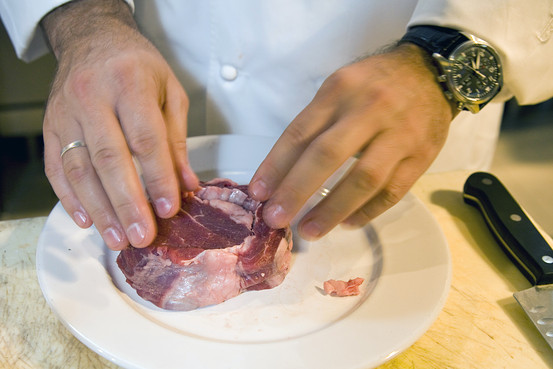
preparing the meat

"Asado is a ritual—it is about people cooking together," explains Mr. Trocca. "They mostly happen on a Saturday or Sunday. We don't plan anything here. They usually happen spontaneously. If you have outdoor space, you have a parrilla."

The main difference between an Argentinean grill and a European one is that in the Argentinean grill the fire is on one side of the pit at the bottom. As the embers become red hot, they are pushed to the other side. The meat is placed over these only, hence the first cardinal rule of grilling in Argentina: Never over an open flame.

Mr. Trocca, 45 years old, loved cooking from an early age. "I used to have a grandmother who was a great chef. The passion comes from there," he says.

In 1985, he started his training in Buenos Aires. Five years later he packed his bags for Europe, where his training included a stint with the legendary Massimo Bottura of Osteria Francescana in Modena, Italy. After moving to New York, where he worked at fashionable culinary hot spot Vandam, he returned in 2001 to open Sucre, which mixes typical asado with modern and European dishes such as octopus carpaccio and whitefish confit with arugula. He has been executive chef at Gaucho Grill for the past three years.
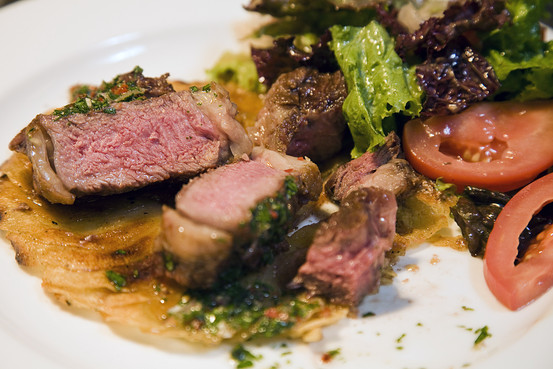
the completed dish

The asado derives from the Spanish asar, to roast, and originated as a gaucho [South American cowboy] ritual. There are still differences with the types of grill found in Mr. Trocca's restaurant and garden, and the ones the gauchos use. Some gauchos still cook in a croce form—whole lambs, for example, are strung up on a cross and cooked slowly next to a fire in the middle. However, in reality, "most gauchos use gas nowadays," Mr. Trocca says. They also prefer their meat to be extremely well done, he says, and this is how it still comes in many Argentine restaurants unless otherwise requested.

The asado starts an hour-and-a-half before eating is to begin, when the fire is lit. Mr. Trocca uses wood only. "Everything is a ceremony," Mr. Trocca says. "I always start by opening a bottle of wine, probably a Torrontes [a white grape from Argentina]. I start with the fire, hand around some salami. First up are the sausages, blood sausage, and chorizo—these are much more fatty than in Europe. Then comes the offal—sweetbreads, kidneys and chinchulines [intestines]—with lots of lemon juice. Only then comes the beef, lamb and pork, often two to three hours into the meal."

Mr. Trocca starts the lesson by showing me how to make chimichurri sauce, a mixture of flat-leaf parsley, garlic, onions, red pepper, dried sweet chili, olive oil and vinegar. He also makes a fresh criollo salsa: simply tomatoes without the seeds, onion and lashings of Argentinean olive oil. In a traditional asado, these are often the only accompaniments to the meat—perhaps with some sweet potatoes that have been baked in foil with olive oil in the fire for 20 minutes, and then slathered in butter.

However, the main event is the meat, and Argentinean steak has the reputation for being some of the best, if not the best, in the world. When asked why, Mr. Trocca explains it is all about geography: "The cows live in the pampas (grasslands), where all they eat is amazing grass. They just walk around, there is no stress and there are no hills, so they have no muscles. It all comes down to diet and muscles." He says that in Europe, he would use Aberdeen Angus, as the closest equivalent.

Mr. Trocca starts to grill a five-centimeter, finely marbled rib-eye on the parrilla, which will take 12-15 minutes in total to be pink in the middle. A good indicator of when to turn it over is when the blood rises to the surface of the raw side. He elaborates on which cuts of beef he favors: asado (short rib), followed by rib-eye and skirt steak. Fillet doesn't stand a chance: "In 10 years in Sucre, I have never had it on the menu, there is no taste as there is no fat. I know how popular fillet is. If it is on the menu, it will sell. I like to re-educate people a bit about different cuts."

One of the most delicious things on the menu, and rarely seen on the barbecues or restaurant menus of Europe, is matambre de cerdo: pork flank steak. After being salted first (no pepper, as with all the meat), it is cooked on the grill for four minutes on either side and served with potato salad.

And what would he never put on a barbecue? "Chicken, unless it is spatchcocked, and fish, which simply doesn't work well."

What does work well, however, is grilled provolone cheese. This is a nod to Argentina's multicultural history, as much of the country's cuisine has Spanish and Italian influences. Here, provolone cheese is simply cut into four-centimeter discs, and left to dry out for a few days, before being grilled for two minutes either side. This is served with chimichurri sauce.

As Mr. Trocca painstakingly layers discs of potato onto a pan—to be served as a sort of potato doily with the beautifully tender rib eye—he explains what he loves most about asado: "It is the most social of all cooking, and, gastronomically, it is what Argentina is most famous for," he says. "There is nothing like a slow asado, all your friends sitting around and talking; I will send out things little by little for them to enjoy. Sometimes it goes on for four hours or longer—to me that is the perfect meal."

Saturday, April 16, 2011

puerta cerrada (closed door)

[from A Gringo in Buenos Aires, 26 March 2010]

Closed-Door Restaurants of Buenos Aires

Closed-door restaurants, a.k.a. restaurantes a puertas cerradas, are big in Buenos Aires. Never heard of them? What closed-door restaurants do is to blur the line between restaurants and dinner parties. They often occur in what is actually the home of the chef, and so necessarily they’re limited to small number of diners. Menus usually change weekly or even daily according to the whims of the chef. They also almost never offer you a choice of dishes; you just get what the chef is cooking on the night you go, which is actually kind of liberating.

The result of all of this is something more intimate and social than a regular restaurant. Going to a closed-door restaurant usually involves meeting and chatting with the chef and the other guests, rather than just eating and dashing. There’s much more a feeling of a shared experience with your fellow diners. Also, the cuisine they offer is often a lot more creative and adventurous than your standard Buenos Aires restaurant fare (which makes a welcome change from meat-and-Malbec).

Casa Saltshaker

The most well-known closed-door restaurant in Buenos Aires is undeniably Casa Saltshaker, which is run by Dan Perlman, author of the influential Buenos Aires restaurant review site at www.saltshaker.net. Casa Saltshaker offers a five-course tasting menu (optionally paired with wine) which changes from one day to the next. Every menu at Casa Saltshaker is themed, and some of the themes are pretty whacky (check out the website). It seats just 12 people in the apartment of Mr. Perlman and his partner Henry Tapia. It’s located in Barrio Norte.

Casa Sunae

Much newer on the puerta cerrada scene is Casa Sunae. The food is ‘pan-Asian’ and both promises and delivers “fiery curries, fresh herbs and exotic spices.” If you’ve been in Buenos Aires for a while and are craving food with flavor, Casa Sunae might be just the thing. There’s a nice patio which is a perfect place to meet the other guests over a cocktail prior to dinner, and the service is also top-notch.

Casa Felix

Casa Felix is another well-established closed-door restaurant. Rock star chef Diego Felix offers a five-course tasting menu for up to 12 people every Thursday, Friday and Saturday night for ARG$150. Guests get a free welcoming cocktail on arrival. Casa Felix operates out of a beautiful house in Chacarita near Colegiales. Unlike some (most?) closed-door restaurants, mingling between guests isn’t all that common. The food at Casa Felix is sublime and consequently it’s wildly popular, and maybe the best-reviewed closed-door restaurant in Buenos Aires.

La Cocina Discreta

Two other highly regarded closed-door restaurants here are La Cocina Discreta, which is located in Villa Crespo and has the capacity to seat 18 diners, and Treintasillas, which is in Colegiales and is run by the talented and creative chef Ezequiel Gallardo.

Treintesillas

If you want to check out the puerta cerrada experience, note that most of them only open for Friday and Saturday nights – obviously if you’re running a restaurant out of your home, you don’t really want to have guests every single night of the week. Bookings are also essential.

Saturday, April 9, 2011

Buenos Aires eats

[many thanks to Cyrus Sarmadi; click on restaurant names below for additional reviews of these & similar restaurants]

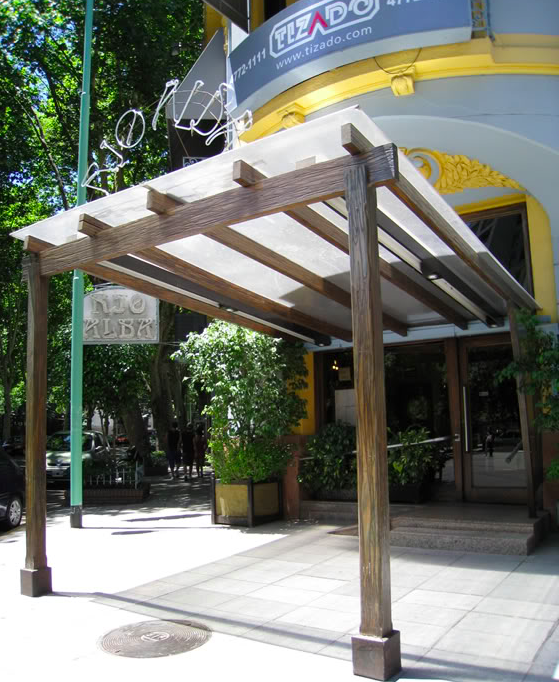
Rio Alba, Avenida Cervino 4499, Buenos Aires, Capital Federal, Argentina, (54-11) 4773 9508


This is a local favorite, I don’t expect you’ll find many tourists there. The atmosphere is casual. The steak is the best that I’ve had so far in Argentina, the salad was very fresh as well.

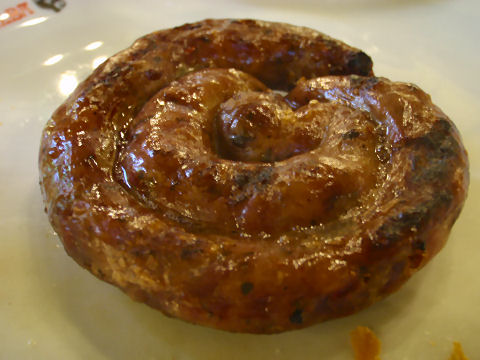
salchicca criolla

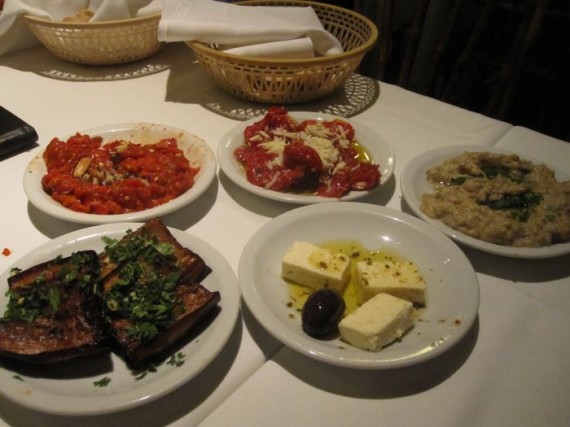
Sarkis, Thames 1101 at Jufré, Villa Crespo, Buenos Aires, Buenos Aires, (54-11) 4772-4911


This Armenian restaurant is in Palermo Hollywood. It had some really delicious Mediterranean dishes. I would get a combination of platters like kabob, hummus, olives, tabouli salad, and so on (they have non-meat selections also). They only take cash.


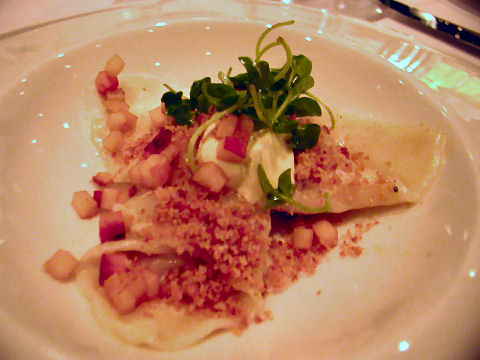
Tegui, Costa Rica 5852, Buenos Aires; (54-11) 5291-3333


This is a fusion restaurant in Palermo Hollywood. The food was good (small portions though) although a bit pricey, the atmosphere is very contemporary, and the service was OK.

rabbit ravioli

Tuesday, April 5, 2011

the best sushi in Buenos Aires

[from Brando, 5 April 2011]

You can find sushi restaurants in all parts of the city, & most offer takeout & delivery.

Tuesday, March 29, 2011

the best pasta in Buenos Aires

According to Brando, Buenos Aires has great pasta restaurants because so many porteños (people who live in Buenos Aires) are of Italian descent. Here's Brando's map of fine pasta restaurants:


Read today's Brando article to learn more.

Monday, March 14, 2011

tamales & humitas

It’s freezing in Salta. Ok, not literally, but last night at 7:30 PM it was 14º C according to a lighted time & temperature display at the corner of Belgrano & Peyreddon. We went out for some exercise & as usual, the walk was far longer than we’d planned. All the restaurants we’d spotted on Saturday night were closed on Sunday.

Finally, we reached El Corredor de las Empanadas at the corner of Zuviría & Necoches. This place has the best tamales & humitas in Salta. Tamales cost 5 pesos; humitas, seladas (salted) or dulces (sweet), 10; un medio litro de vinto tinto de casa (a half liter of red house wine) 10. So for 30 pesos we enjoyed 2 tamales, 1 humita selada, a basket of bread served with picante (very spicy) sauce, & wine.

The humitas are to die for, so good that I sit for a while with each mouthful, refuse to swallow until I’ve savored & savored the taste. 

Sunday, March 13, 2011

eating & sleeping & shopping

Sometimes it seems that all we do here is eat & drink. I'm not complaining.

Last week in Cafayate we got to longing for pork chops, so we dropped by a Super Pollo on Calle Calchaqui near the plaza. The signs on the wall said cerdo (pork) but listed no prices. We took a number & waited while others bought unbelievable amounts of bife (beef) & some pollo (poultry). I also studied the carved-up vaca (cow) chart & picked out the useful fact that lomo means loin.

When a fellow behind the counter called out ochenta y dos (#82), I asked whether he had lomo de cerdo. Yes, he did, so I asked whether it had os (bone) or not. Both, he said, so yippee, I asked for 2 bone-in loin pork chops. He looked in the chest freezer & found no pork, so he headed into the walk-in freezer & returned shortly with a frozen bone-in pork loin. After cutting a thin chop, he held it up for me to see. Demasiado delgado (too thin), I said. ¿Mas grueso (thicker)? he asked. Sí, I said. We walked out with 2 thick chops that cost us 15 pesos. They were delicious.

Every time we come to Salta, we stop at a hole-in-the-wall cheese shop on San Martin for a half kilo of white, semi-hard, goat cheese that we break easily into chunks & eat off & on all day. To find the shop, cruise the north side of the 800 block.

Our jaunt along San Martin was in search of a colchón (mattress), 2 por 2 (2 meters square). Numerous folks told us to go to MaxiKing, but we found MaxiKing's mattresses too duro (hard) for us. We are bony, & I am arthritic. It was odd to find at least 5 stores all selling MaxiKing brand within 2 blocks, but Salta & Buenos Aires are like this. They have single-use shopping districts. We walked through the music & the bookstore shopping districts in Buenos Aires a few weeks ago.

Because our favorite mattress ever was a Simmons, we trekked over to Alto NOA shopping mall at 6 PM & sprawled on a few Beauty Rests. Blandito (soft), we kept saying. Yup, we found one we liked, only 6+K pesos, at least 4 times the price of a high-end MaxiKing, but hey, we sleep a lot. Fascinating to learn that getting a mattress delivered to Cafayate costs only about 150 pesos.

Friends told us today that when we go Simmons to buy the mattress, we should tell them what we want, offer 5K pesos cash, & see what happens. They also told us about buying their new camioneta (pickup). They withdrew cash of the ATM for days on end & borrowed cash from everyone they knew & went to the car dealer with cash, the only way to get a good price, that is to say a good price here, where cars are not cheap.

On the way back from Vaqueros, the same taxi driver recommended a lunch place, Charrua, muy muy bueno, he said, so we went. It's on the corner of Caseros & Vicente Lopez. Of course we were the first ones there, but wow, it filled to bursting by the time we left. Couples, families with children, multi-generational families, etc., & most of them seemed to be regular customers.

Because we pigged out on bife de chorizo last night at La Lenita on Balcarce, we ate pollo today. Mike's meal was a fabulous pollo al ajillo con papas. After the first taste, he said he could now translate ajillo (garlic). His papas (potatoes) were thin rounds cooked golden & semi-crispy. I only ate 2, because I was scarfing down my pollo curry which came in a baked basket made of herbed cracker dough (exquisite) along with rice & sauteed red/green/yellow sweet peppers. For all this plus bread with condiments, a half liter of vino tinto, & a bottle of agua con gas, la cuenta (bill) came to 88 pesos.

The waiter at Charrua, like many waiters here, ask where we're from & what we're doing here. Our answers of Hawaii & building a house in Cafayate bring smiles. In the middle of last night's meal, the waiter gave us a regalo (gift) of steaming hot, fresh-made empanadas. The Charrua waiter today gave us regalos of limoncello, an icy cold lemon-flavored drink served in liqueur glasses, absolutely delicious. I look forward to buying a bottle.

For tonight, I'm thinking 1 tamale & 1 glass of wine. Moderation, right?

Monday, February 28, 2011

Argentine food

[many thanks to Forrest Beck for this post]

I just bought SaltShaker Spanish-English-Spanish Food & Wine Dictionary - Second Edition, a book you may want to make your readers aware of since I have personal experience using it. It is another dictionary, but unique in that it focuses largely on Argentinian foods. The author is Dan Perlman who runs saltshaker.net, a great website for anyone who enjoys trying to locate good food and wine in Buenos Aires. I bought the first edition when Nicole and I lived in Argentina for 4 months in 2007/08. This updated version contains 3000 more entries, but most importantly comes in a Kindle version so I can use it on my iphone/iPad in BA (though I'm not toting my iPad around BA anytime soon).

Tuesday, February 8, 2011

where to eat fish in Buenos Aires

[from La Nación, 8 February 2011]

Los mejores restaurantes para comer pescado en Buenos Aires

Clasico español: Restaurante Vasco Francés, Moreno 1370, Montserrat | Tel: 4381-5415


Se pueden pedir fritas, a la milanesa o a la plancha. El plato, para compartir, cuesta $75. Los chopitos, de entrada, son una verdadera fiesta: calamares pequeñitos rellenos con sus propios tentáculos y salteados a la plancha con cebollitas $66. El resto de los platos resultan una verdadera gozada: el pulpo a la gallega $180, los cachetes de abadejo a la vizcaína $53 y, claramente, la paella, que viene servida en pequeñas ollitas calientes ideales para raspar el fondo con el arroz pegado. Los arroces merecen un apartado especial con sus atractivas variedades: el negro vasco francés (con tinta de calamar, vieiras y langostinos, $135) y el especial (con centolla, langostinos, setas y crema, $160). Todos los pescados pueden pedirse con un surtido de salsas.

En clave peruana: Primavera Trujillana, Franklin D. Roosevelt 1627, Belgrano | Tel: 4706-1218


Si la idea es hacer un recorrido marítimo por el paladar, te sugerimos pedir el hit de la casa: camarones al ajillo ­-según el día, pueden ser langostinos-, que vienen con morrón, ajo en crema de achacote y arroz. Todos los principales cuestan $50 y se pueden servir con distintas intensidades de picante según la tolerancia del comensal. Otra especialidad para sumar en tu lista de opciones es el ceviche mixto, es decir, pescado y mariscos cocidos al limón con cilantro, especias varias y cebolla colorada.

Sabor portuario: Don José, Avenida Alvear 423, Martínez | Tel: 4798-4860

Los mariscos, por supuesto, son los protagonistas de la carta. La llamada "Fritanga" augura una comida memorable con langostinos, rabas, cornalitos y calamaretes. Si superás semejante entrada, entonces, estás listo para sumergirte en las profundidades de una cazuela de mariscos y moluscos (que cuesta $90 y alcanza hasta para tres personas). Una opción para los menos atrevidos son las pastas caseras con salsas de mariscos, como, por ejemplo, los escandalosos tallarines al bocco ($78, para compartir).

De pelicula: Nemo, Cabello 3672, Palermo | Tel: 4802-5308


Si querés hacer un paseo completo por el mundo de la pesca, entonces, podés elegir entre el tapeo de mar o el tableo de pescado. El primero viene con 14 platitos de mejillones, langostinos, camarones, brótola y otras opciones que no se repiten. Mejor, para compartir $145. Si vas "a por" el segundo, te vas a encontrar con 700 gramos de pescado surtido que propone como constante el salmón y las especialidades del día: abadejo, lenguado, corbina, mero y pacú del río, entre otros $150. El arroz, las papas a la plancha y distintas terrinas acompañan el desfile acuático. Nemo no ofrece pescado frito de ninguna clase ni tampoco excesos de condimentos, sino que, el foco está puesto en los sabores esenciales. Atención con el pulpo, siempre bien preparado, servido con papas al natural, sin trozar y con los tentáculos enteros, $89 el plato.

La pesca esencial: Sólo Pescado, Anchorena 533, Abasto | Tel: 4861-0997


Las especialidades de la casa: desde merluza, pasando por langostinos, trucha del sur, pejerrey, salmón, abadejo y cornalitos hasta paellas, ceviches y gambas al ajillo. En síntesis, todos los platos marítimos en sus correspondientes versiones porteñas, italianas y españolas. Por eso, lo mejor, para evitar confusiones, es acercarse al mostrador y preguntar por la pesca del día para que el cocinero, siempre sincero y honesto, recomiende cocciones y guarniciones. Con $50 comés más que bien.

Friday, October 29, 2010

San Salvador de Jujuy

We highly recommend staying at Apart El Huancar at Belgrano 851 in the center of town. Because they did not have a doble, they gave us for the same price (300 pesos) a 4-person apartment -- 2 floors, living room, dining room, kitchen, bedroom, full & half bath, & terrace, plus parking in a garage around the corner for 35 pesos per night. We like it so much we plan to stay for at least 2 nights.

Last night we ate llama picante across the river @ Picanteria y Restaurant Locoto, especialidad en comidas regionales, José de la Iglesia 1113. Good sauce, we found the the meat good tasting, somewhat like pork, but too dry. We'd like to try slow-cooking it Hawaiian-style.